Finding your strengths in a birth chart: a self-reflection guide
A birth chart gives you language for your strengths. Read the chart as a whole rather than judging from one placement. This guide covers the order for reading strengths and how to use the results.
Start with Sun, Moon and Ascendant
The Sun (purpose), the Moon (emotional pattern and what feels safe) and the Ascendant (how you meet the world) form the outline of the person. Comparing their signs and houses shows the difference between outward expression and inner movement.
Overall balance: elements and modalities
Counting planets by element (fire, earth, air, water) and modality (movable, fixed, dual) shows pace, need for stability and flexibility of thought.
| Element | Typical tendencies |
|---|---|
| Fire (Aries, Leo, Sagittarius) | Drive, initiative, expression |
| Earth (Taurus, Virgo, Capricorn) | Practicality, persistence, making things real |
| Air (Gemini, Libra, Aquarius) | Thought, language, connecting |
| Water (Cancer, Scorpio, Pisces) | Empathy, focus, depth |
Find the planets that work strongly
Dignity, closeness to the angles and aspects show which planets work most readily; their roles are where strengths tend to show. In Jyotish, look at the Lagna lord, planetary strength and yogas. Planets that stand out in both systems deserve particular attention.
Compare with a personality test
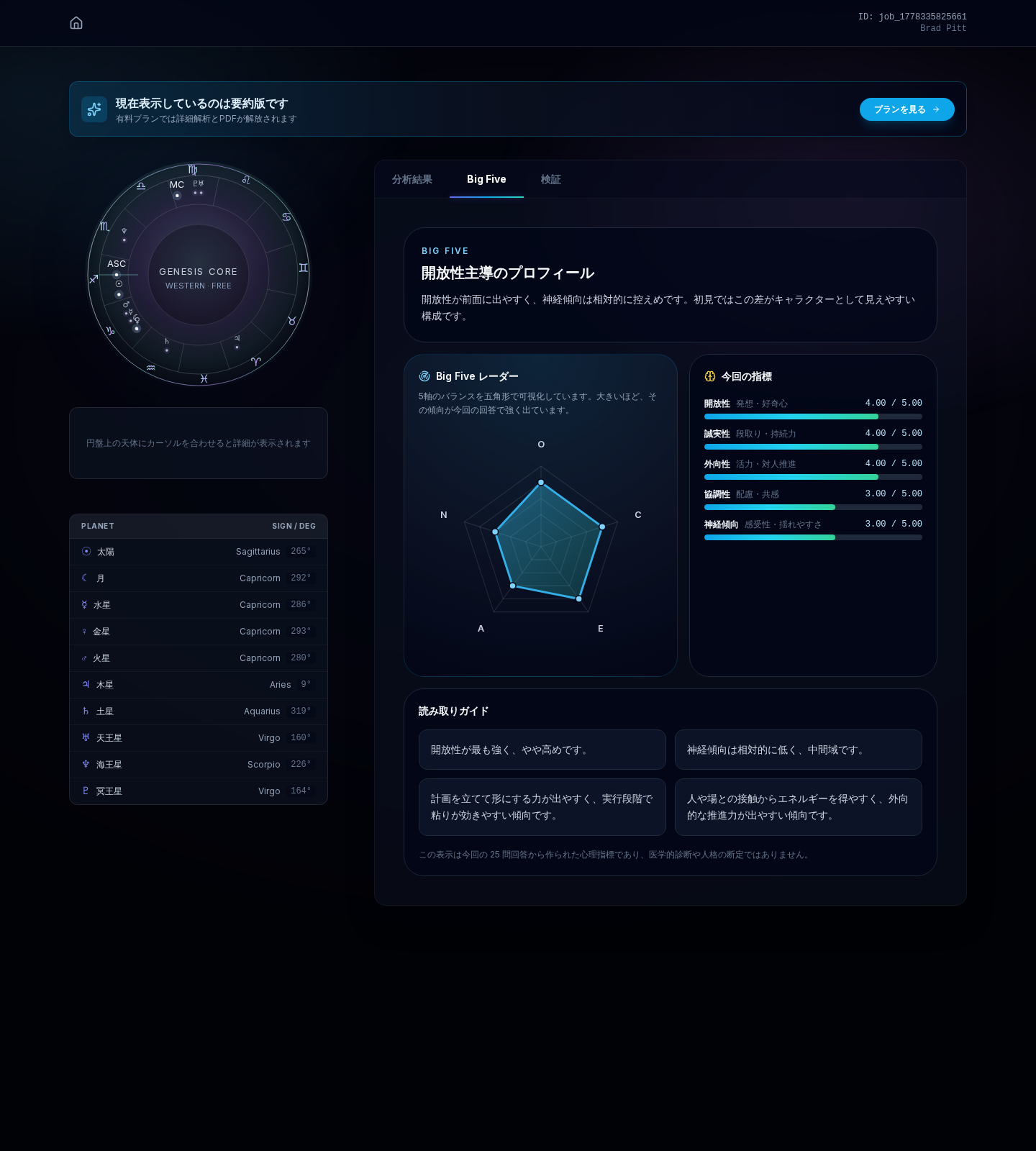
GenesisCore's free version offers an optional 20-question Big Five assessment (openness, conscientiousness, extraversion, agreeableness, neuroticism) that you can compare with the chart analysis. The free version requires research participation consent.
Steps for self-reflection
- Write down up to three strongly placed planets and their roles
- Summarise your preferred way of working from the element and modality balance
- Recall situations where those strengths showed
- Compare with your personality results and put the overlap in your own words
- Use the conditions where your strengths work as criteria for choices
What GenesisCore shows
GenesisCore calculates both systems separately and analyses character and strengths. The free version shows one system's basic result; Standard and Premium deliver both systems and Five Social Paths as PDFs.
FAQ
- How does a chart show strengths?
- Through the Sun, Moon and Ascendant, well-placed planets, ruler chains and house placements.
- How is this different from a personality test?
- It reads your planetary positions at birth instead of answers to questions; you only enter your birth date, time and place.
GenesisCore
Read your own chart through both systems.
Try one system free. Standard (four PDFs) and Premium (six PDFs) are one-time purchases that include both Western astrology and Jyotish.
Launch prices until Nov 15, 2026, 23:59 JST: Standard 2,980 JPY → 2,235 JPY / Premium 5,980 JPY → 4,485 JPY
Related guides
- Western astrology vs. Indian astrology (Jyotish): the key differencesWhy do Western astrology and Indian astrology (Jyotish) give different results f…
- How to read a birth chart, and why your birth time mattersA birth chart is built from your date, time and place of birth. Learn how the As…
- What an AI astrology analysis shows: strengths, work and timing through two systemsWhat can GenesisCore's AI astrology analysis tell you? How it calculates Western…
- How to explore career direction with astrologyWhere to look in a birth chart for career direction: the Western 10th house and …
- What is Dasha? Reading life periods in Indian astrologyDasha divides life into planetary periods in Indian astrology. Learn how the 120…
- What is the Navamsa (D9)? How the ninth-division chart is built and readThe Navamsa (D9) divides each sign into nine parts of 3°20′. Learn how the start…
- What is a nakshatra? The 27 lunar mansions of Indian astrologyNakshatras divide the zodiac into 27 lunar mansions of 13°20′. See the list with…
- What is the Ascendant (Lagna)? The starting point of the birth chartThe Ascendant (rising sign) is the degree of the zodiac on the eastern horizon a…
- Sun sign vs. Moon sign: how to find them and how each system reads themYour Sun sign comes from your birth date; your Moon sign changes about every two…
- Astrology houses: the meaning of the 12 houses and house systemsThe houses divide a birth chart into twelve areas of life such as work, relation…
- Astrology transits: reading timing from current planetary positionsTransits overlay current planetary positions on the birth chart to read timing. …
- Synastry: reading compatibility by comparing two birth chartsSynastry compares two birth charts to read a relationship. Learn which planets m…
- The Midheaven (MC) and your calling: reading your public role in the chartThe Midheaven (MC) is the highest point of the birth chart and a key to career a…
- Yogas in Vedic astrology: key combinations and how to read themA yoga in Jyotish is a planetary combination that meets defined conditions. Lear…
- The D10 (Dasamsa) chart: reading career and public lifeThe D10 (Dasamsa) divides each sign into ten parts and is used in Jyotish to rea…