Jyotish / Indian astrology
Jyotish is an astrological tradition developed in India. It uses a person's birth date, time, and place to map the celestial positions at that moment and to interpret character and periods of life.
It begins with the same birth information as Western astrology, but uses a different reference for zodiac positions and different methods for reading time. The word Jyotish also covers wider traditions of calendars, celestial calculation, and choosing times; modern English often calls its natal-chart traditions Indian astrology.
- 01Twelve fixed zodiac divisions / Rāśi
- 02Eastern horizon at birth / Lagna
- 03Celestial placements in the divisions / Graha
The Lagna and body positions are illustrative and do not represent a specific person.
Birth date, birth time, and birthplace produce the celestial configuration at birth.
The celestial positions for that moment are calculated first. The eastern horizon at the birthplace sets the chart's starting point, and positions are placed in twelve zodiac divisions referenced toward the stars. This chart becomes the foundation for finer divisions and timing methods.
- The celestial bodies and calculated points that show what acts
- Graha
The Sun, Moon, planets, and the two lunar-node points Rahu and Ketu are among the bodies used.
- The twelve zodiac divisions that show how it acts
- Rāśi
They divide a star-referenced zodiac into twelve 30-degree sections.
- The twelve life areas that show where it appears
- Bhāva
They organize experience from the birthplace view of the sky.
- The eastern-horizon point that starts the chart
- Lagna
It is the zodiacal degree rising at the birthplace and is sensitive to birth time and place.
Four roles combine to form the base chart.
Celestial bodies show what acts; zodiac divisions show how it acts; life areas show where it appears; and the eastern horizon sets the starting point. Jyotish calls these Graha, Rāśi, Bhāva, and Lagna. Their base arrangement is called D1.
- The base chart showing the whole birth configuration
- D1 / Rāśi chart
It is the foundation for supporting charts and timing methods.
- A rule that links life areas through their ruling planets
- Lordship
The planet responsible for each zodiac division connects topics across the chart.
- A rule for how a celestial body relates to another position
- Drishti
Traditional rules specify which bodies regard which positions.
- A named pattern formed by several placements
- Yoga
It tests whether planets, rulers, and positions meet defined conditions.
- A way to weight how a celestial body can act
- Strength
Different methods evaluate condition, placement, direction, time, and other factors.
The starting point of the zodiac can change a placement near a boundary.
The season-based positions common in Western astrology and the star-referenced positions common in Jyotish are offset. The value used to correct that offset is called ayanāṃśa. Different standards can move a celestial body or the chart's starting point into another zodiac division near a boundary.
The Moon's position can be divided more finely, and topic-specific supporting charts can be added.
A method that divides the Moon's path into twenty-seven sections is called Nakshatra; each section has four smaller units called Pada. A method that remaps the same birth positions into a topic-specific supporting chart is called Varga. These layers support rather than replace the base chart.
- Divide the Moon's position into twenty-seven sections
- Nakshatra
Each section spans 13°20′ and is closely linked with lunar motion and some timing systems.
- Divide one lunar section into four smaller units
- Pada
Each Pada covers 3°20′.
- A ninth-division chart that supports evaluation of condition
- D9 / Navāṃśa
It is an important supporting chart, though emphasis varies by school.
- A tenth-division chart that supports reading work and public activity
- D10 / Daśāṃśa
It adds a focused view of work, social activity, and execution.
Life is divided into nested periods and compared with current celestial motion.
A method that divides life into long and short periods, each associated with a ruling celestial body, is called Dasha. The widely used Vimshottari system distributes 120 years among nine bodies. Comparing the current sky with the natal chart is called Gochara, and it is often read alongside the period structure.
- A long period that frames the broader phase of life
- Mahadasha
One celestial body governs a span of several years.
- A shorter period nested inside the long period
- Antardasha
Each major period is divided among the nine bodies and may be subdivided further.
- A sequence that distributes 120 years among nine bodies
- Vimshottari sequence
Ketu 7, Venus 20, Sun 6, Moon 10, Mars 7, Rahu 18, Jupiter 16, Saturn 19, Mercury 17 years.
- Overlay current celestial motion on the natal chart
- Gochara
Current positions are combined with, but kept distinct from, the period structure.
Fixed divisions, Lagna, and celestial placements appear in GenesisCore's square chart.
In D1, the interface places Lagna and celestial bodies around fixed zodiac positions, then provides switches for the supported divisional charts.
- 01Twelve outer cells: fixed zodiac positions
- 02Lagna: the eastern horizon at birth
- 03Abbreviations in cells: celestial placements
- 04Top switches: D1 and supported divisional charts
Move from the base chart to supporting layers.
This English Standard artifact was generated from Albert Einstein’s published birth data and includes a separate Jyotish report. Begin with the printed input and base chart, then use the divisional and timing evidence included in the selected deliverable.
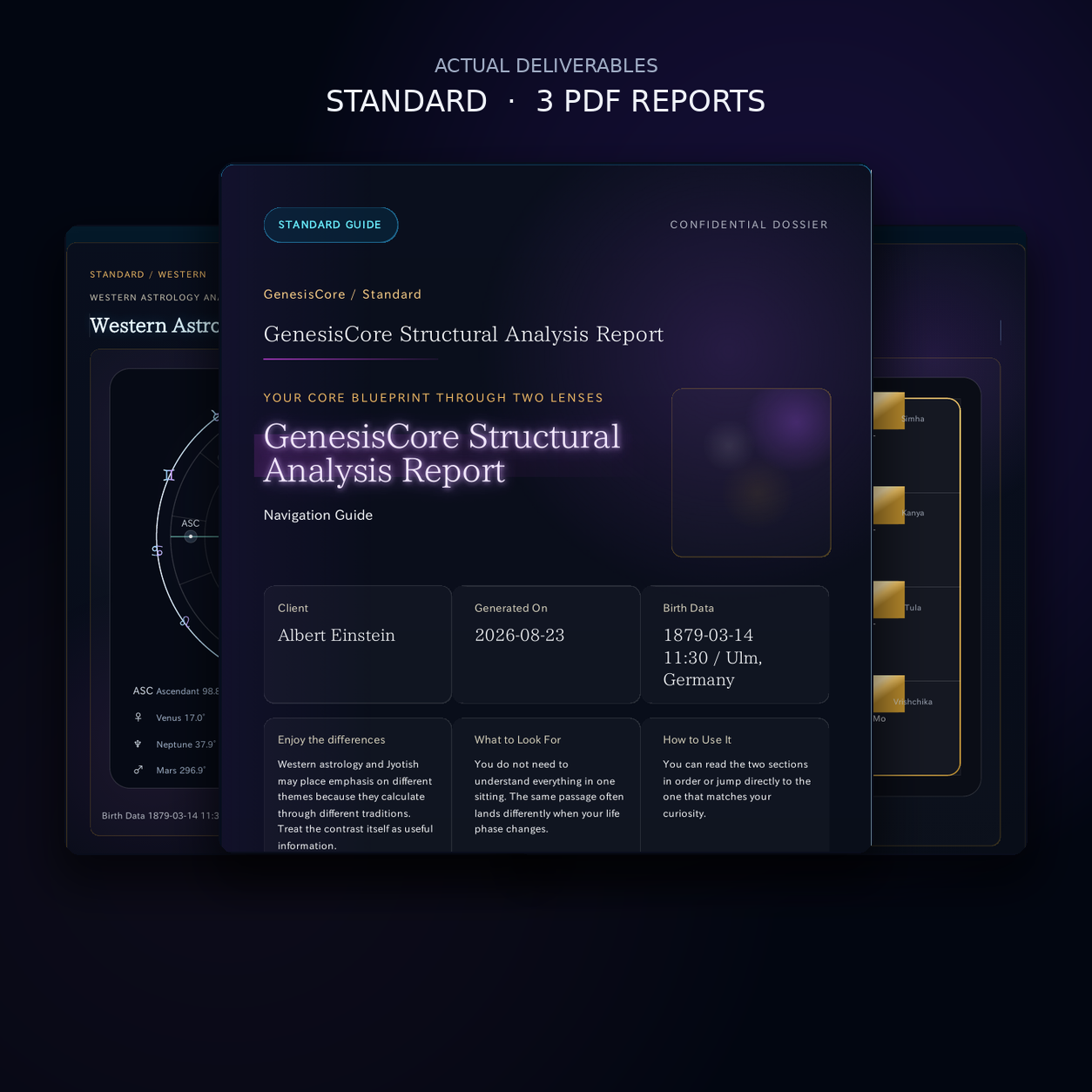
- 01
Input and base chart
Confirm the printed birth record and the Jyotish report generated from itThe base chart and Lagna are the foundation for later layers.
- 02
Graha, Rāśi, and Bhāva
Read the report's calculated placements before the proseUse lordship and relations to connect the chart areas.
- 03
Supporting charts
Use only the Varga included by the selected plan and calculation contractA divisional chart supports rather than replaces D1.
- 04
Timing evidence
Dasha and Gochara belong to dedicated timing layersKeep the period ruler, current motion, and integrated interpretation distinguishable.
Calendrical time, mathematical astronomy, and natal astrology developed in layers.
Early Jyotiṣa was closely tied to calendrical and ritual timing and to the motion of the Sun, Moon, and Nakshatras. Mathematical astronomy and later exchanges with Greek- and Persian-speaking knowledge worlds contributed to the development of personal horoscopy.
- 01
Calendars and Nakshatra
Knowledge of lunar and solar motion, seasons, and ritual timing was organized. The dating of Vedāṅga Jyotiṣa remains a scholarly question.
- 02
Mathematical astronomy
Methods for calendars, planets, and eclipses developed toward later Siddhānta literature.
- 03
Expansion of natal astrology
Materials associated with Yavanajātaka and Varāhamihira are important evidence for cross-cultural exchange and Indian reconstruction.
- 04
Accumulation of judgment techniques
Yoga, Varga, Dasha, annual methods, question charts, electional methods, and extensive commentary traditions developed.
- 05
Regional practice and software
Chart layouts, ayanāṃśa, Bhāva, and Dasha practice remain plural while print and software have widened access.
Display and calculation conventions vary by region and school.
North Indian charts commonly fix life-area positions, while South Indian charts commonly fix zodiac-division positions. The same calculated longitudes can therefore look different. Ayanāṃśa, house, divisional-chart, and period practice also vary by school.
- 01Birth-time error can affect Lagna, Bhāva, Varga, and some Dasha boundaries.
- 02North Indian formats commonly fix Bhāva positions; South Indian formats commonly fix Rāśi positions.
- 03A statistical test of Indian natal charts found no above-chance performance on its limited academic-ability classification task. Jyotish is not established as a reliable scientific method for predicting personality or events.
- 04It does not replace medical, legal, financial, diagnostic, or other high-stakes professional judgment.
GenesisCore lets readers switch among the base chart, supported divisional charts, periods, and analysis.
The current Premium interface includes D1 and supported divisional charts, Lagna, current Dasha, Yoga count, timing views, first-pass analysis (L1), and integrated interpretation (L2).
D1 and supported Varga
Displays D1 plus selectable D9, D10, D12, D30, and other supported chart modes.
Jyotish snapshot
Summarizes Lagna, current Dasha, Yoga count, and related evidence.
Premium L1 / L2
Separates placement-level analysis from integrated interpretation.
Period view
Displays implemented Dasha and Gochara information on a dedicated surface.
The wider tradition
The product does not claim coverage of every Varga, Dasha, Yoga, Muhurta, or Prashna method.
Sources for history, calculation, and scientific evaluation
- University of Oxford Research ArchiveCalendars, rituals, and astral science in India
The intertwined history of calendars, ritual, astronomy, and astrology in India.
- Cambridge University PressMain Characteristics and Achievements of Ancient Indian Astronomy
Vedāṅga Jyotiṣa, Nakshatra, and the history of calendrical computation.
- BrillThe Jewel of Annual Astrology
Scholarly translation and analysis of technique exchange, annual methods, and period systems.
- Bulletin of SOAS / CambridgeThe Yavanajātaka of Sphujidhvaja — review record
A bibliographic entry point to a major source in the history of Indian horoscopy.
- Current ScienceA statistical test of astrology
A statistical test of Indian natal astrology on a limited academic-ability classification task.
Western astrology reads the same birth data through a different rule system.
Free lets you choose one system. Standard and Premium deliver both as separate outputs.