Western astrology: a beginner's guide
Western astrology uses a person's birth date, time, and place to map the sky at that moment, then gives symbolic meaning to the positions and relationships in that map. This map is called a natal chart.
It begins with the same birth information as Jyotish (Indian astrology), but usually uses a different reference for zodiac positions and different methods for reading time. Its circular natal chart combines celestial bodies, zodiac divisions, life areas, and the angles between bodies.
- 01Set the eastern-horizon ASC and meridian MC axes
- 02Place the twelve-sign zodiac band
- 03Divide the inner layer into twelve houses
- 04Place the celestial bodies
The zodiac band, house boundaries, and body positions are illustrative. House boundaries vary with the calculation method and birth conditions; this is not a chart for a specific person.
Birth date, birth time, and birthplace reconstruct the sky at birth.
Local time is converted into a calculation standard and the celestial positions for that moment are found. The eastern horizon and local north–south line orient the map for the birthplace. This time-and-place-specific map is called a natal chart.
- A map of the sky made from the input
- Natal chart
It places celestial positions and the local orientation of the sky in one diagram.
- The band the Sun appears to travel over a year
- Ecliptic
It provides a reference for celestial positions and is divided into twelve zodiac signs.
- The point on the eastern horizon that orients the chart
- Ascendant
It is the degree of the ecliptic rising at the birthplace and is sensitive to time and location.
- The point on the local meridian that sets the vertical axis
- Midheaven / MC
It is a principal chart angle derived from the ecliptic and the birthplace meridian.
A natal chart combines four roles.
Celestial bodies show what acts; zodiac divisions show how it acts; life areas show where it appears; and angular relationships show how two bodies connect. Western astrology calls these planets, signs, houses, and aspects.
- 01Sun's apparent path / ecliptic360°
- 02Zodiac divisions / signs12
- 03Life areas / houses12
- 04Celestial actors / planetsposition
- 05Planetary relations / aspectsangle
- What acts
- Planets
The Sun, Moon, and planets; some schools add asteroids or calculated points.
- How it acts
- Twelve signs
Twelve equal 30-degree divisions of the ecliptic.
- Where it appears in life
- Twelve houses
Twelve experience areas calculated from the birthplace view of the sky.
- How two planets relate
- Aspects
Angles such as conjunction, opposition, square, trine, and sextile.
- How the chart is oriented
- Four angles
ASC, DSC, MC, and IC are principal axes determined by time and place.
The same birth information can change under different division and tolerance rules.
A chart changes when the zodiac starts from the seasons or is adjusted toward a stellar reference, when life areas are divided by a different method, or when a larger angular tolerance is accepted. These choices are called the zodiac, house system, and aspect orb.
A reading combines role, condition, area, and relationship.
After combining planets, signs, houses, and aspects, a reading can add the rule that links each zodiac sign to a planet, a traditional evaluation of a planet's condition, and the chain of rulers across the chart. These are called rulership, dignity, and dispositorship.
- The rule that links zodiac signs to planets
- Rulership
Sign rulers connect life areas and placements into a chain.
- A traditional measure of condition by zodiac sign
- Essential dignity
Categories include domicile, exaltation, detriment, and fall.
- A traditional measure of capacity within the chart
- Accidental dignity
Approaches consider proximity to angles, house placement, speed, and related conditions.
- A way to follow the planet responsible for an occupied sign
- Dispositor
It links separate placements into a chart-wide chain.
The natal chart can be compared with current motion, symbolic motion, and repeating cycles.
One method overlays the present sky; another advances the birth chart at a symbolic rate; another casts a new chart whenever the Sun returns to its birth position; and another assigns a focus by age. These are called transit, secondary progression, solar return, and profection.
- Overlay the current sky on the natal chart
- Transit
Actual planetary positions at a later time are compared with the birth chart.
- Advance the natal chart at a symbolic rate
- Secondary progression
A representative method equates one day after birth with one year of life.
- Cast a new chart when the Sun returns to its birth position
- Solar return
It creates a chart for an approximately annual cycle.
- Assign a life area or planet by age
- Profection / time lord
Traditional methods shift emphasis by age or period.
The same four layers appear in GenesisCore's circular chart.
The interface keeps the outer zodiac band and inner houses as separate layers, then adds birth-condition axes and calculated celestial positions in one wheel.
- 01Outer ring: the twelve zodiac signs
- 02Inner layer: numbered Houses 1–12
- 03ASC and MC: axes derived from birth conditions
- 04Body symbols: calculated positions
Read a calculated report in four passes.
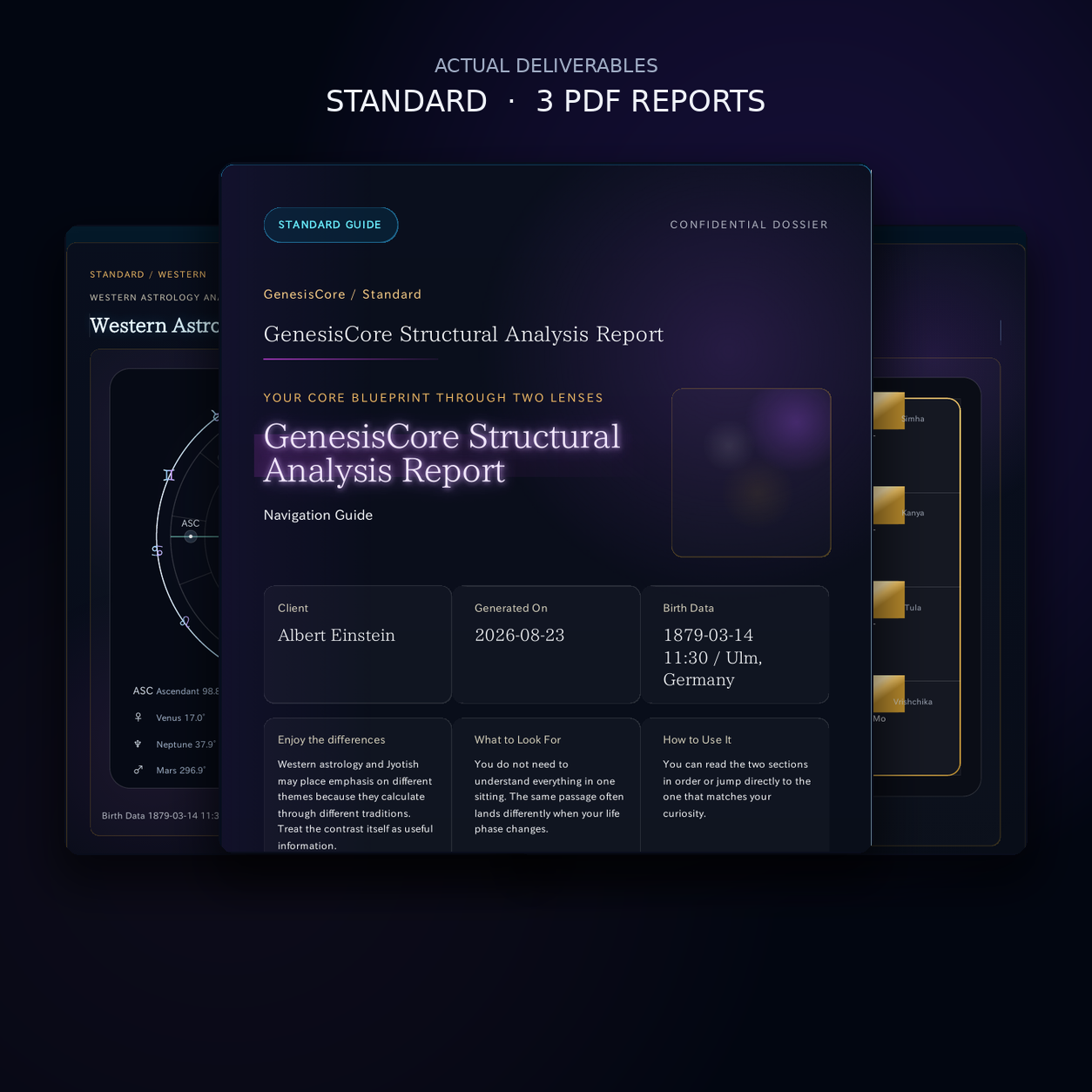
This English Standard artifact was generated from Albert Einstein’s published birth data. Begin with the printed input and chart, then move through placements, relationships, and the delivered interpretation.
- 01
Input and angles
Confirm the named subject, birth date, time, and location printed on the artifactThe chart's observer-dependent angles are only meaningful with the input record attached.
- 02
Chart evidence
The Western report shows the wheel, ASC, and a placement listRead positions and chart structure before the interpretation text.
- 03
Relations and themes
Use the report's placement and aspect evidenceCombine sign, house, rulership, and angular relations rather than reading isolated keywords.
- 04
Delivered interpretation
The guide and Western report are separate files in the Standard setKeep navigation guidance, calculated evidence, and prose interpretation in their own roles.
Several knowledge cultures shaped the techniques used today.
Mesopotamian celestial omens and zodiacal divisions, Hellenistic natal horoscopy, Arabic and Persian translation and computation, and Latin transmission changed the tradition’s methods and uses across time.
- 01
Mesopotamian celestial omens
Records of planets, eclipses, and weather were linked to royal and social omens and supplied foundations for later zodiacal and planetary interpretation.
- 02
Zodiac and personal charts
Babylonian zodiacal calculation met geometrical and philosophical ideas in Greek-speaking and Egyptian settings; the Ascendant and twelve places became central to natal horoscopy.
- 03
Arabic and Persian scholarship
Greek works were translated, compared, annotated, and developed alongside astronomical tables and instruments.
- 04
Latin circulation and print
Translations carried the material into European courts, medicine, calendars, learned culture, and printed practice.
- 05
Modern plurality
Traditional revival, psychological astrology, contemporary consultation, and computer calculation now coexist.
Modern practice is diverse; astrology is not an established scientific prediction method.
Western astrology continues as a historical and cultural knowledge system and is used in consultation, self-reflection, and symbolic interpretation. Modern science has not established reliable personality or event prediction from natal charts.
- 01Uncertain birth time makes the Ascendant, MC, houses, and time-dependent techniques uncertain.
- 02When comparing results from different schools, check the zodiac, house system, and aspect-orb settings.
- 03Interpretation does not replace medical, legal, financial, diagnostic, or other professional judgment.
- 04Cultural meaning, calculation reproducibility, psychological usefulness, and predictive accuracy are separate research questions.
GenesisCore places the natal chart and analysis in the same result interface.
The current result interface displays the natal chart, placements, aspects, analysis, and timing information. Premium separates placement-level analysis (L1) from integrated interpretation (L2).
Natal chart and calculation record
Displays the wheel, planetary placements, aspects, and related chart evidence.
Premium L1 / first-pass analysis
Connects placement-level evidence to specific themes.
Premium L2 / integrated interpretation
Presents cross-placement synthesis separately from L1.
Period view
Paid results display the currently implemented timing information by period.
The wider tradition
The product is not a complete implementation of horary, electional, synastry, and every historical technique.
Sources for history, calculation, and scientific evaluation
- Internet Encyclopedia of PhilosophyHellenistic Astrology
Historical foundations, Hellenistic natal astrology, and philosophical context.
- Oxford Research EncyclopediaAstrology in Ancient Greek and Roman Culture
The zodiac, planets, houses, aspects, and ancient practice.
- The Metropolitan Museum of ArtAstronomy and Astrology in the Medieval Islamic World
Translation, computation, instruments, and practice in the medieval Islamic world.
- European Space AgencyTime References
Astronomical background for the equinox and precession.
- NatureA double-blind test of astrology
A representative double-blind test of natal-chart personality description.
The second system is Jyotish / Indian astrology.
It uses the same birth data but a different reference frame, chart language, and timing structure.