What an AI astrology analysis shows: strengths, work and timing through two systems
An AI astrology analysis turns calculated birth-chart data into a written analysis tailored to the person. GenesisCore calculates Western astrology and Indian astrology (Jyotish) separately and has AI interpret each within its own system. This guide explains what the analysis covers, which parts use AI and which do not, and what each plan delivers.
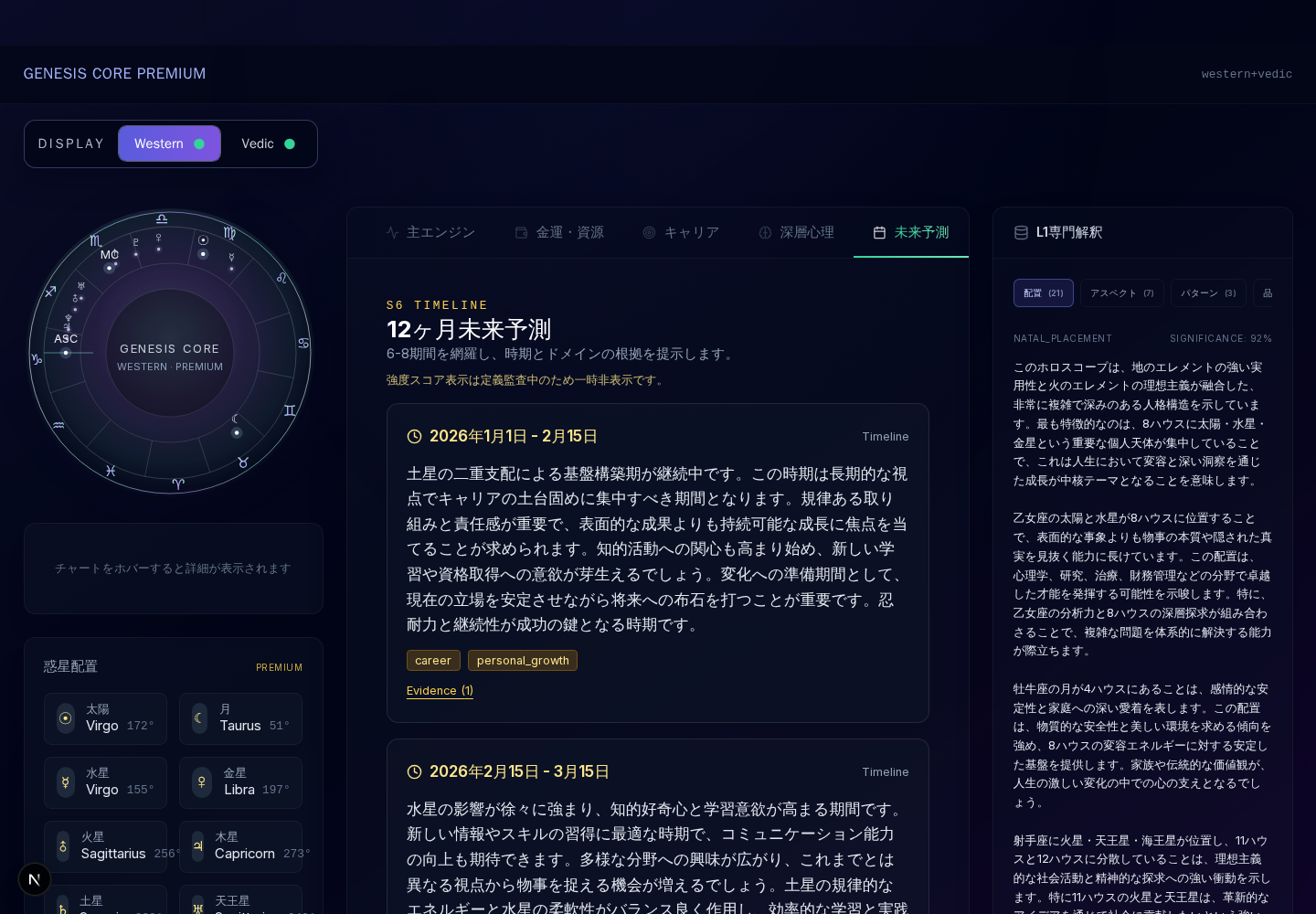
Themes the analysis covers
GenesisCore reads the following themes from the chart, organised as material for self-reflection and for thinking about work and direction.
- Character and strengths: thinking patterns, strengths and challenges
- Work: motivations and ways of working
- Money: how you relate to resources
- Relationships: boundaries, interactions and connections
- Timing: period-by-period themes from past to future (paid plans)
How it works: calculation per system, interpretation by AI
First, planetary positions are calculated from your birth data and a chart is built under each system's rules: signs, houses and aspects for Western astrology; Lagna, bhāvas, yogas, divisional charts and Dasha for Jyotish.
AI then interprets that data within each system and writes an analysis tailored to you. Because the systems are not blended or forced to agree, you can compare how the same person reads from two perspectives. Premium separates the placement-by-placement primary analysis (L1) from the integrated interpretation (L2).
The part without AI: Five Social Paths
Five Social Paths, included in Standard and Premium, uses no AI. Placements are classified by fixed rules and explanations come from a reviewed dictionary. The five paths are advocacy, authored and symbolic production, organized collective realization, technology and product implementation, and embodied competitive performance. They describe how action shows up, not job categories, and several can coexist in one person.
The result screen shows which paths match, which placements led there and public figures who share a path, with a one-page PDF.
Using it for strengths and career thinking
The analysis works best as language for your tendencies and as material for choices. Strengths that both systems point to are a natural starting point for how you work and which roles you choose; where the systems differ, compare which side of you each one is describing.
Period views organise themes and time windows worth attention; they do not promise specific events. For medical, legal or financial decisions, consult a qualified professional.
What Free, Standard and Premium deliver
| Plan | Systems | What you receive |
|---|---|---|
| Free | Western or Jyotish | Basic result on screen (requires research participation consent; 20 Big Five questions optional) |
| Standard | Western + Jyotish | One analysis per purchase. Four PDFs: guide, Western, Jyotish, Five Social Paths |
| Premium | Western + Jyotish | One analysis per purchase. L1 and L2, six PDFs including the guide and Five Social Paths |
Getting started
Start with the free version to see one system's result, then move to a paid plan. If you choose a paid plan directly, you enter your birth details, confirm the content and price, pay, and then start the analysis. Paid purchase does not require research participation. When it is complete, open the result screen and receive the PDFs by email.
FAQ
- What is the difference between Free and paid?
- Free shows one system on screen. Standard (four PDFs) and Premium (six PDFs) include both Western astrology and Jyotish, and both are one-time purchases.
- Is there a monthly fee?
- No. Standard and Premium are one-time purchases.
- What do I need to enter?
- Your birth date, birth time and birthplace. Without a birth time the analysis covers what can be calculated.
GenesisCore
Read your own chart through both systems.
Try one system free. Standard (four PDFs) and Premium (six PDFs) are one-time purchases that include both Western astrology and Jyotish.
Launch prices until Nov 15, 2026, 23:59 JST: Standard 2,980 JPY → 2,235 JPY / Premium 5,980 JPY → 4,485 JPY
Related guides
- Western astrology vs. Indian astrology (Jyotish): the key differencesWhy do Western astrology and Indian astrology (Jyotish) give different results f…
- How to read a birth chart, and why your birth time mattersA birth chart is built from your date, time and place of birth. Learn how the As…
- How to explore career direction with astrologyWhere to look in a birth chart for career direction: the Western 10th house and …
- Finding your strengths in a birth chart: a self-reflection guideHow to read strengths from a birth chart: Sun, Moon and Ascendant, element and m…
- What is Dasha? Reading life periods in Indian astrologyDasha divides life into planetary periods in Indian astrology. Learn how the 120…
- What is the Navamsa (D9)? How the ninth-division chart is built and readThe Navamsa (D9) divides each sign into nine parts of 3°20′. Learn how the start…
- What is a nakshatra? The 27 lunar mansions of Indian astrologyNakshatras divide the zodiac into 27 lunar mansions of 13°20′. See the list with…
- What is the Ascendant (Lagna)? The starting point of the birth chartThe Ascendant (rising sign) is the degree of the zodiac on the eastern horizon a…
- Sun sign vs. Moon sign: how to find them and how each system reads themYour Sun sign comes from your birth date; your Moon sign changes about every two…
- Astrology houses: the meaning of the 12 houses and house systemsThe houses divide a birth chart into twelve areas of life such as work, relation…
- Astrology transits: reading timing from current planetary positionsTransits overlay current planetary positions on the birth chart to read timing. …
- Synastry: reading compatibility by comparing two birth chartsSynastry compares two birth charts to read a relationship. Learn which planets m…
- The Midheaven (MC) and your calling: reading your public role in the chartThe Midheaven (MC) is the highest point of the birth chart and a key to career a…
- Yogas in Vedic astrology: key combinations and how to read themA yoga in Jyotish is a planetary combination that meets defined conditions. Lear…
- The D10 (Dasamsa) chart: reading career and public lifeThe D10 (Dasamsa) divides each sign into ten parts and is used in Jyotish to rea…