What is the Navamsa (D9)? How the ninth-division chart is built and read
The Navamsa (D9) is one of the most important divisional charts (vargas) in Jyotish. It rearranges the positions of the base chart (D1) in finer divisions to support the reading of planetary condition and deeper life themes.
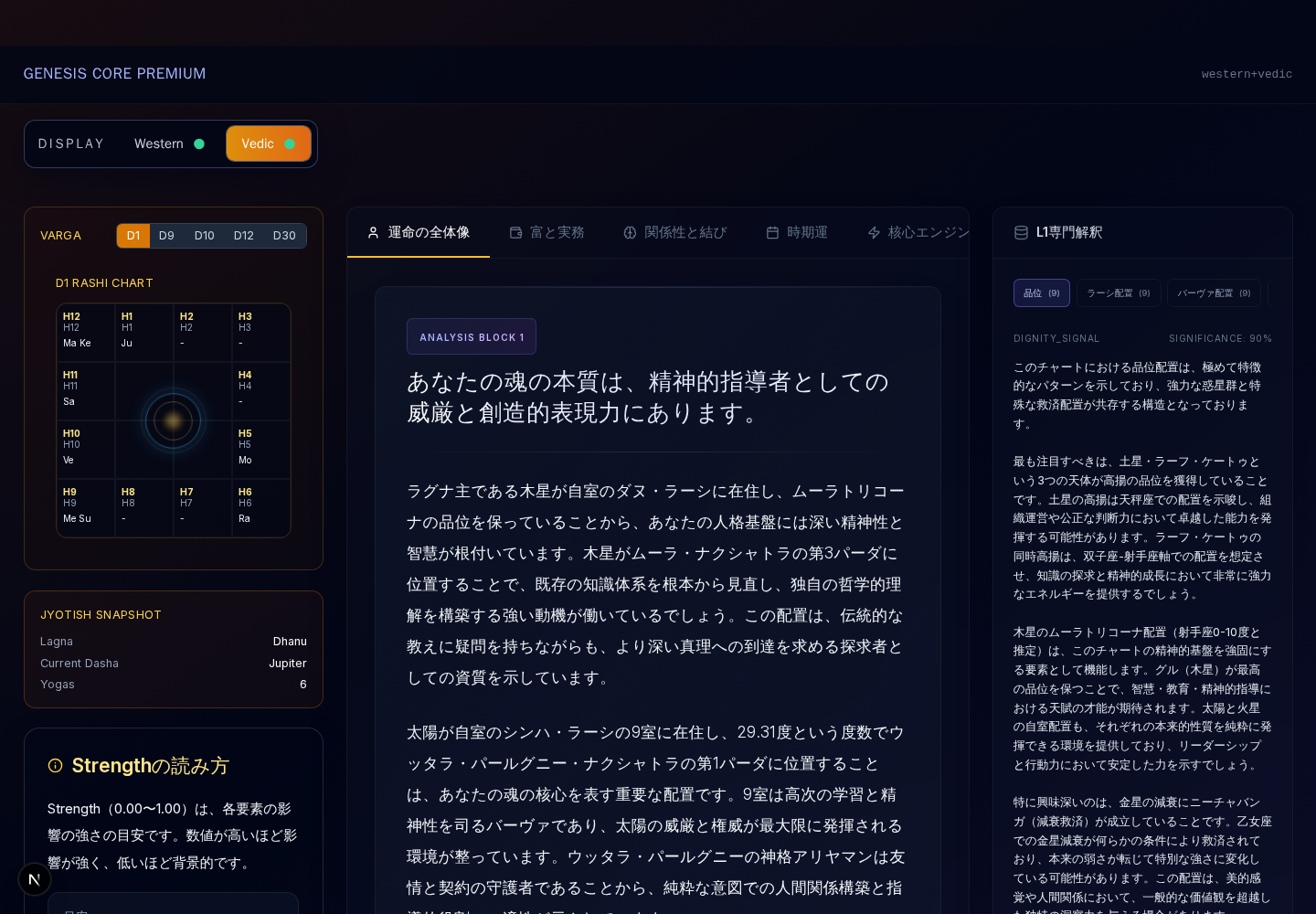
Divisional charts (vargas)
Divisional charts rearrange the same planetary positions for specific purposes: the D9 Navamsa, the D10 Dashamsha for work and social activity, the D12, the D30 and others. They support the D1 rather than replace it.
Building the D9: nine parts of 3°20′
Dividing a 30° sign into nine gives parts of 3°20′, the same width as a nakshatra pada; the zodiac holds 108 of them.
The starting sign depends on the original sign's modality: movable signs (Aries, Cancer, Libra, Capricorn) start from the same sign, fixed signs (Taurus, Leo, Scorpio, Aquarius) from the ninth sign, dual signs (Gemini, Virgo, Sagittarius, Pisces) from the fifth. In effect fire signs start from Aries, earth from Capricorn, air from Libra and water from Cancer.
| Modality | Signs | D9 starts from |
|---|---|---|
| Movable | Aries, Cancer, Libra, Capricorn | the same sign |
| Fixed | Taurus, Leo, Scorpio, Aquarius | the ninth sign |
| Dual | Gemini, Virgo, Sagittarius, Pisces | the fifth sign |
Vargottama
A planet (or the Lagna) in the same sign in both D1 and D9 is vargottama, traditionally valued as a consistent expression of that planet. Within each sign it is the first part for movable signs, the fifth for fixed signs and the last for dual signs.
Reading the D9
Use the D9 to check the condition of planets seen in the D1: whether a prominent planet stays well placed or changes condition. Traditionally the D9 is also read for marriage, partnership and deeper life themes; emphasis varies by school.
The D9 Lagna changes about nine times as fast as the D1 Lagna, on average roughly every 13 minutes, so an accurate birth time allows finer judgement.
How GenesisCore handles it
On the GenesisCore Premium Jyotish screen you can switch between the D1 and supported divisional charts such as D9, D10, D12 and D30, moving between chart structure, divisional charts and Dasha periods while reading L1 and L2.
FAQ
- What is the Navamsa (D9)?
- A divisional chart that splits each sign into nine parts, used alongside the D1 for partnership and the underlying strength of planets.
- Does the D9 need a birth time?
- Yes. Each division is 3°20', so the D9 Lagna can change within minutes.
GenesisCore
Read your own chart through both systems.
Try one system free. Standard (four PDFs) and Premium (six PDFs) are one-time purchases that include both Western astrology and Jyotish.
Launch prices until Nov 15, 2026, 23:59 JST: Standard 2,980 JPY → 2,235 JPY / Premium 5,980 JPY → 4,485 JPY
Related guides
- Western astrology vs. Indian astrology (Jyotish): the key differencesWhy do Western astrology and Indian astrology (Jyotish) give different results f…
- How to read a birth chart, and why your birth time mattersA birth chart is built from your date, time and place of birth. Learn how the As…
- What an AI astrology analysis shows: strengths, work and timing through two systemsWhat can GenesisCore's AI astrology analysis tell you? How it calculates Western…
- How to explore career direction with astrologyWhere to look in a birth chart for career direction: the Western 10th house and …
- Finding your strengths in a birth chart: a self-reflection guideHow to read strengths from a birth chart: Sun, Moon and Ascendant, element and m…
- What is Dasha? Reading life periods in Indian astrologyDasha divides life into planetary periods in Indian astrology. Learn how the 120…
- What is a nakshatra? The 27 lunar mansions of Indian astrologyNakshatras divide the zodiac into 27 lunar mansions of 13°20′. See the list with…
- What is the Ascendant (Lagna)? The starting point of the birth chartThe Ascendant (rising sign) is the degree of the zodiac on the eastern horizon a…
- Sun sign vs. Moon sign: how to find them and how each system reads themYour Sun sign comes from your birth date; your Moon sign changes about every two…
- Astrology houses: the meaning of the 12 houses and house systemsThe houses divide a birth chart into twelve areas of life such as work, relation…
- Astrology transits: reading timing from current planetary positionsTransits overlay current planetary positions on the birth chart to read timing. …
- Synastry: reading compatibility by comparing two birth chartsSynastry compares two birth charts to read a relationship. Learn which planets m…
- The Midheaven (MC) and your calling: reading your public role in the chartThe Midheaven (MC) is the highest point of the birth chart and a key to career a…
- Yogas in Vedic astrology: key combinations and how to read themA yoga in Jyotish is a planetary combination that meets defined conditions. Lear…
- The D10 (Dasamsa) chart: reading career and public lifeThe D10 (Dasamsa) divides each sign into ten parts and is used in Jyotish to rea…